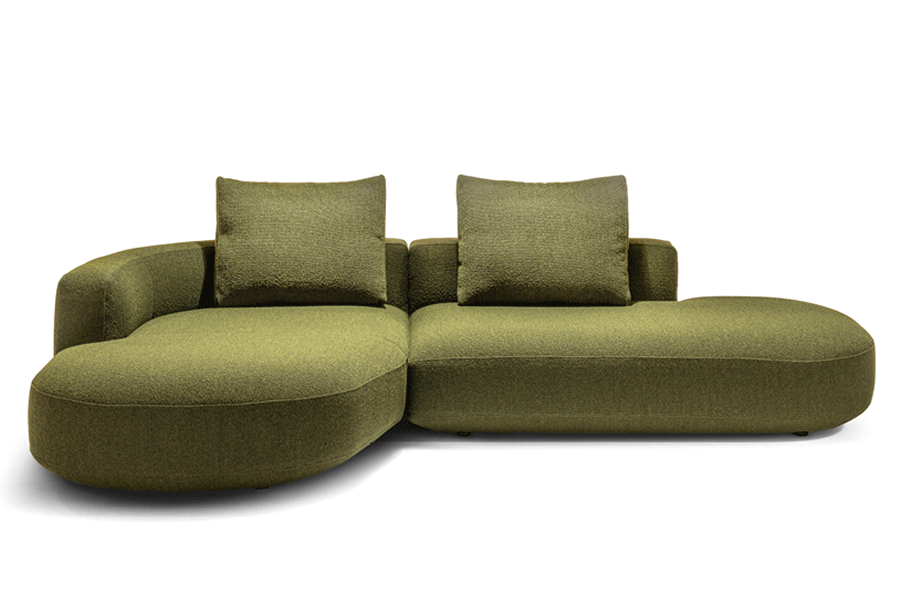
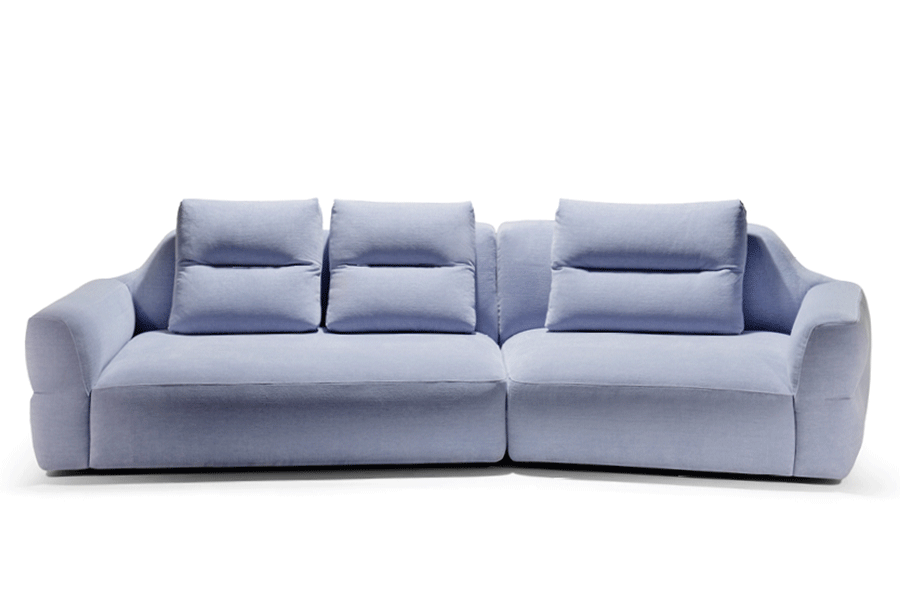
Comfort, innovation and material research. These are the principles behind Zanotta's upholstered pieces, conceived not as mere furnishings but as systems designed to last and evolve over time. Today, this vision translates into the renewal of two of the catalogue's most representative sofas.Forms grow softer, space opens up to new combinations. Zanotta renews Fedrigo by Vincent Van Duysen and Pianoalto+ by Palomba Serafini Associati, following a shared thread: new curved geometries and upholstery in CIRCULARREFOAM®, a polyurethane made a percentage of recycled polyols.
This choice confirms Zanotta's direction towards lower-impact materials, without compromising on comfort. For the second year running, Zanotta renews its dialogue with Vincent Van Duysen, expanding the Fedrigo project with solutions that follow its natural evolution. Curved modules and asymmetric end pieces are added to the modular system, allowing for freer configurations that can follow the geometry of any room and adapt to the space and needs of those who live in it.The elements that made Fedrigo iconic remain unchanged: the fluid lines of the backrest merging into the armrests, the generous proportions, a visual lightness that offsets the sofa's dimension. It's a comfort that can be perceived at a glance, before you even sit down. This attention to materials translates into concrete choices. The upholstery uses CIRCULARREFOAM®, a polyurethane made with a percentage of recycled polyols and PET fibre containing post-consumer recycled content. The entire system is also fully disassemblable: no adhesives, with every component easily separated at the end of its life to be recycled or recovered. This choice is part of the broader material research that Zanotta continues to pursue in the production of its upholstered pieces.
The curve also redefines Pianoalto+ by Palomba Serafini Associati. A bestseller since its launch, the project was conceived as a platform: a modular system capable of evolving across time and space from a clear conceptual base, one to be built upon and extended.This is where much of its success lies. Over the years, the modules developed have explored new relationships with space: first with peninsula elements that broke away from orthogonality, and now with a further evolution that works to eliminate the sharp edge altogether. New sinuous elements broaden its compositional possibilities and open up a more dynamic dialogue with the surrounding space, while the new CIRCULARREFOAM® upholstery further refi nes its sense of welcome.The compositions presented at Milan Design Week 2026 push this research towards an idea of upholstery as nest: a place of refuge and gathering that, in its more intimate configurations, comes close to a kind of domestic existence minimum. An intimate, personal, even slightly self-indulgent space in which to retreat when coming home, or whenever the need is felt to shelter from the outside world. A piece with an unmistakable language of its own, Pianoalto+ thus confirms its versatility: flexible solutions ready to adapt to any interior project, in a consistently coherent balance of comfort, aesthetic quality and sustainability.Two projects, different in author and character, yet united by the same direction: the softness of the curve as a new formal vocabulary, and a choice of materials in keeping with Zanotta's ongoing material research, embodied in the use of CIRCULARREFOAM® and in the removable covers of both systems. This is how Zanotta continues to treat the sofa as a field of research, where attention to detail and to materials move forward hand in hand.
.png)